
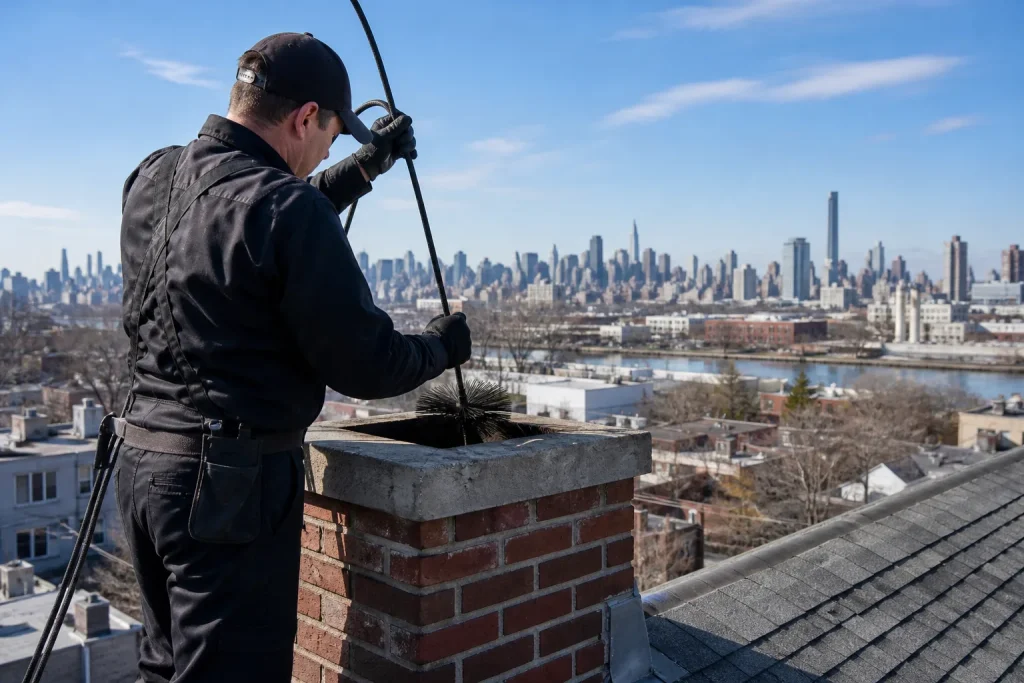
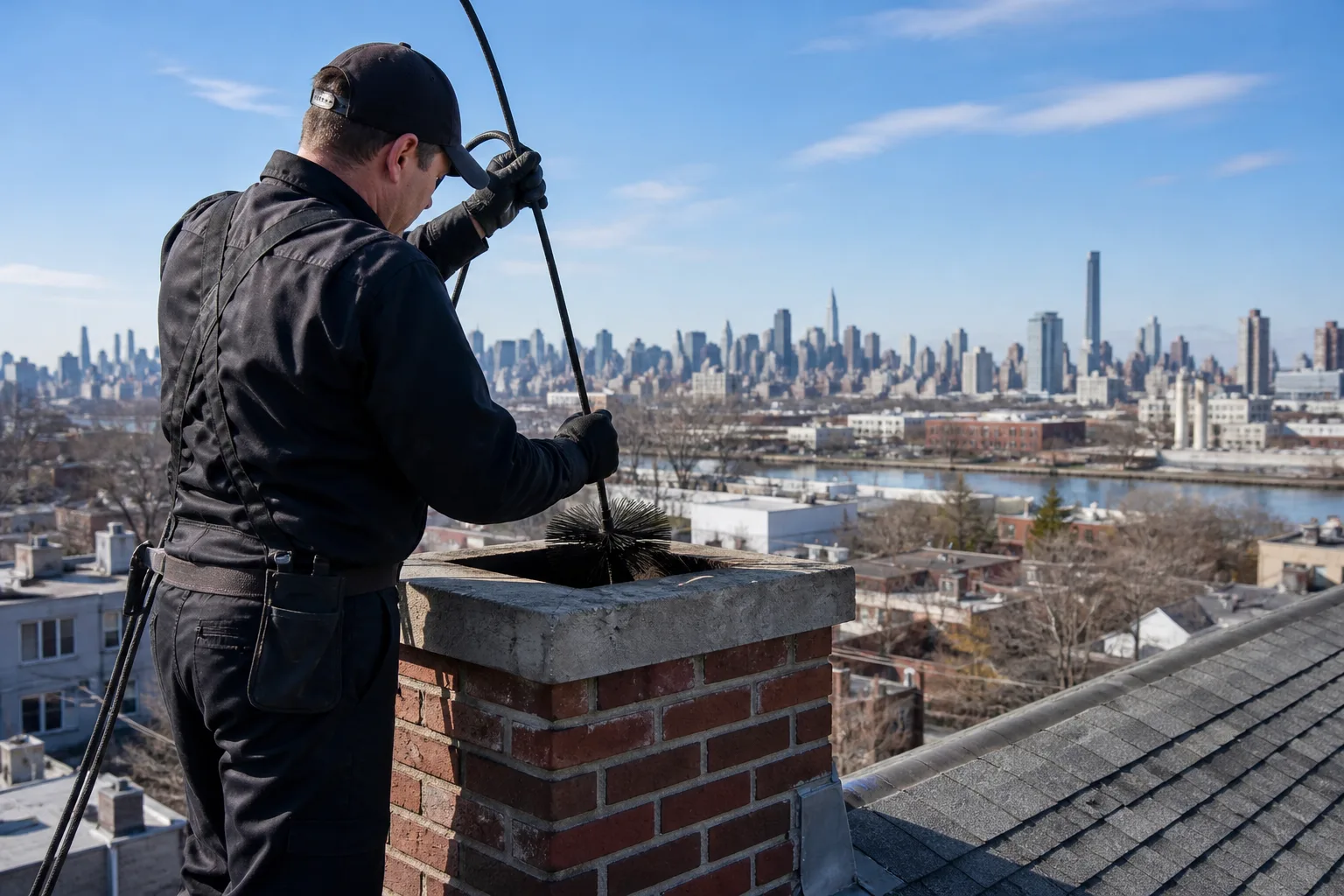
HeatShield Chimney Sweep in Mott Haven: A Homeowner’s Guide
The most expensive chimney mistake we see in Mott Haven isn’t a skipped sweep. It’s HeatShield ceramic flue sealant applied to a flue that wasn’t properly prepared first. HeatShield is a repair system, not a cleaning product, and it only bonds to a flue wall that’s been swept down to bare, sound masonry and inspected for active damage. Applied over creosote or spalled brick fragments, it fails quietly from the inside out. You won’t see the delamination until the next inspection opens the flue and finds it. If you’d rather leave the diagnosis to a specialist, call (855) 726-7555 and we’ll inspect first, recommend second.
What HeatShield Actually Does to Your Flue Wall
HeatShield is a Cerfractory Flue Sealant: a ceramic-cement compound applied as a coating to the inside of an existing chimney flue. It doesn’t line the flue with a new pipe. It resurfaces what’s already there, restoring a smooth, continuous, heat-resistant inner face over masonry that has cracked, pitted, or started to spall.
Think of it as similar in concept to repointing a brick wall rather than rebuilding it. The existing flue stays. The compromised surface gets replaced with a joint-free ceramic layer that seals cracks, smooths rough mortar joints, and closes the tiny gaps where creosote and moisture collect.
What it treats well:
- Hairline to moderate cracking in clay tile liners
- Rough or eroded mortar joints between tiles
- Minor spalling on the flue face, provided the tile itself is structurally whole
- Flues that are out of round or slightly offset, where a rigid liner won’t fit cleanly
What it does not fix: a flue with a broken or displaced tile, a flue with missing sections, or a flue whose clay has separated from the surrounding masonry. Those are structural failures, and coating a failed structure just hides the problem. In our experience across older Mott Haven masonry buildings, that distinction decides the whole repair. It’s the first thing we check.
HeatShield Resurfacing vs. Full Reline: Which Deterioration Profile Fits Which Repair
The short answer: HeatShield is for a flue whose tile is intact but whose surface is compromised. A reline is for a flue whose tile is broken, missing, or no longer sound. If the tile is structurally gone, no coating will hold.
Here’s how we sort it:
| Condition | Typical repair | Why |
|---|---|---|
| Hairline cracks, rough joints, minor pitting | HeatShield resurfacing | Tile is sound; the surface just needs restoring |
| Moderately spalled but structurally whole tile | HeatShield resurfacing | Coating rebuilds the inner face without removing the flue |
| Broken, displaced, or missing tile sections | Full reline (DuraFlex stainless system) | There’s no sound substrate for a coating to bond to |
| Flue separated from surrounding masonry | Full reline | Structural failure; needs a new continuous liner |
| Out-of-round or offset flue, tile intact | HeatShield resurfacing | Coating conforms where a rigid liner won’t |
The reason this matters in Mott Haven is the housing stock. A lot of the neighborhood’s masonry chimneys are older than the appliances now vented through them, and the flues show wear patterns that sit right on the line between “resurface” and “reline.” Guessing wrong in either direction costs money. Resurfacing a failed flue wastes the application. Relining a flue that only needed a coating replaces a sound structure. When we find that line, we’ll show you the camera footage before anything gets booked, so you can see the condition yourself. Our chimney repair work starts from that same inspection.
The Pre-Application Sweep Protocol: Why It’s More Intensive Than an Annual Cleaning
A standard annual cleaning removes creosote, soot, and debris so the flue can be inspected and used safely. A pre-HeatShield sweep does that and then keeps going. The flue has to be brought down to clean, sound masonry, because the coating bonds to the surface it’s applied over. Anything left behind becomes a failure point.
What the prep involves:
- Full sweep of the flue to remove all creosote and soot, including glaze-stage deposits on older flues
- Mechanical removal of loose material: spalled brick fragments, crumbling mortar, and any delaminating tile surface
- Camera inspection of the full flue length to confirm the substrate is sound and to map the exact area to be resurfaced
- Surface prep and priming to manufacturer spec, because the primer is what the ceramic layer actually bonds to
- Application and controlled curing, with the flue protected from moisture and airflow across the curing window
That fourth and fifth step is where shortcuts happen. HeatShield has a specified curing time. A crew that rushes it, or applies over a flue that wasn’t fully cleaned, gets a coating that looks fine on day one and delaminates on the inside months later. If you want a proper annual cleaning first, a chimney sweep is the right starting point, and we’ll tell you during that visit whether the flue is even a HeatShield candidate.
How to Verify a Contractor Is Applying HeatShield to Manufacturer Spec
You can’t watch the inside of your flue from the living room, and most homeowners never get a clear view of the application itself. What you can do is ask the right questions before work starts and check the evidence after it’s finished.
- Ask what the prep includes. If the answer is “a sweep and then we apply it,” that’s a red flag. Full prep, priming, and the substrate check should all be part of the scope.
- Ask for before-and-after photos of the flue, not just the firebox. A proper application documents the swept, primed flue and the finished surface.
- Confirm curing time is built into the schedule. Rushing the cure is the single most common way an application fails.
- Check that the inspection came first. HeatShield should be recommended after an inspection, never sold as a package before anyone has seen inside the flue.
HeatShield requires manufacturer certification to apply it correctly, and the difference between a certified application and a rushed one shows up years later. We apply it to spec and document the work, and we’ll show you the camera photos so you’re not taking our word for it. At the top of the flue, the chimney cap & crown matters too, since water getting past a failed crown is one of the things that erodes a flue in the first place.
If your home inspection report flagged the chimney for documentation, an inspection aligned with NFPA 211 standards gives you a written record of the flue condition before and after the repair. That’s often what a buyer or an insurer wants to see.
When HeatShield Is the Right Call, and When It Isn’t
HeatShield is the right repair when the flue is sound at its core and the deterioration is a surface problem. It’s the wrong repair when the structure itself has failed. Framing it in dollars helps, but the real question is what your flue can safely support.
Choose HeatShield when:
- The clay tile is intact but cracked, pitted, or has rough joints
- The flue is out of round or offset and a rigid liner won’t fit
- You want the flue resurfaced without opening up the chimney breast or breaking out tile
- A full reline would be overkill for the level of wear present
Choose a full reline (we use DuraFlex stainless systems) when:
- Tiles are broken, displaced, or missing
- The flue has separated from the surrounding masonry
- The structure can’t provide a sound substrate for any coating
- You’re upgrading the flue for a new appliance that needs a specific venting system
Moisture, heat, and time are hard on masonry, and the combination shows up differently in every flue. In our experience, the honest answer is sometimes “this can wait until next season,” and we’ll say so plainly. Nothing gets recommended without camera evidence you’ve seen yourself.
When to Call a Pro
Resurfacing a flue is work for a certified applicator, and it isn’t a job to take on yourself. The prep alone needs proper sweeping equipment and a camera inspection, and the application depends on manufacturer-specified priming and curing. Getting it wrong means paying twice. If your flue has active creosote, spalled brick, or a home inspection flagged it, book an inspection before anyone talks about a coating or a liner. The flue condition should decide the repair, not a sales conversation.
Related services in Mott Haven: we handle sweeping, inspection, repair, and cap and crown work under one company, so you don’t need to source a second contractor when the inspection turns up a follow-up issue.
The Bottom Line
HeatShield is a resurfacing repair, not a cleaning service, and it only performs when the flue has been thoroughly swept, mechanically prepped, primed, and cured to spec. It’s the right call for sound tile with surface deterioration. It’s the wrong call for a structurally failed flue, which needs a full reline. Whatever your flue needs, the honest starting point is an inspection with photos you can see for yourself. If you’re in Mott Haven and need help, Chimney Sweep Mott Haven offers free estimates, call (855) 726-7555. We answer 24/7. Fast dispatch from 7am to 7pm, Sunday through Friday. Our technicians have up to 14 years of experience, and our Chimney Sweep Mott Haven team works with professional-grade brands including HeatShield, DuraFlex, and Gelco caps.
Frequently Asked Questions
What is HeatShield chimney sweep service in Mott Haven, and do I need it?
HeatShield is a ceramic flue sealant applied to the inside of a chimney flue to resurface cracked or rough masonry. You need it if your flue has hairline cracks, pitted mortar joints, or minor spalling but the clay tile is still structurally sound. Only an inspection can confirm that. Call (855) 726-7555 for a free estimate.
How much does HeatShield resurfacing cost in Mott Haven?
Pricing is set per job by a written estimate after inspection, since the cost depends on the flue size and the extent of prep and deterioration. We don’t quote a number before seeing the flue, and there’s no service-call fee for the estimate. Call (855) 726-7555 and we’ll book an inspection.
Can HeatShield be applied over creosote or old soot?
No. The flue must be swept down to bare masonry and any spalled material removed before priming and application. Coating over creosote or loose fragments prevents the sealant from bonding, and the application fails from the inside out. Call (855) 726-7555 to schedule a pre-application sweep and inspection.
Do I need a full reline instead of HeatShield?
You need a reline if the clay tile is broken, displaced, missing, or separated from the surrounding masonry, because there’s no sound substrate for a coating to hold to. If the tile is sound and only the surface is worn, resurfacing is the right repair. An inspection with camera footage settles which one you need. Call (855) 726-7555 for a free estimate.
Written by the team at Chimney Sweep Mott Haven.
Need Chimney Cleaning Help?
Call Chimney Sweep Mott Haven - the local pro we connect you with is licensed and insured, here with fast help in Mott Haven.
(855) 726-7555